Monday, February 19, 2018

If All the World Were Paper....

Way back in 2007, I was living in the San Francisco bay area and was doing my part to help the Northern California AOSA chapter prepare to host the national conference in San Jose.  Aside from loaning instruments from my school and presenting a recorder session, most of my duties involved the AOSA boutique.  Those of you who have been to a national conference know that the host chapter sponsors a boutique full of teaching materials, manipulatives and ideas.  A portion of the funds raised at the boutique go toward local chapter scholarships for professional development.  Anyway, as part of the boutique committee, I spent several Saturdays meeting with chapter members to make ribbon streamers, abstract artwork note cards and small percussion instruments.  I also put together a collection of original canons written by chapter members and contributed a lesson idea to another book titled Simple Play.  

Over the years, I have really embraced the concept of Simple Play - using everyday objects and a bit of imagination to create engaging lessons in movement and music.  One of my favorites has become a simple piece of paper.  What started out as a simple folding activity has grown into imaginative play, creative movement and found sound performances.

Paper Play #1:  Found Sounds

In 2012, I was presenting a session at the St. Louis national conference.  The focus of the session was on using little pieces from the Music for Children volumes as resource material for new lessons.  The culminating piece was a take on the very well know "Ding Dong Diggidiggidong" from Volume One.  Using its sixteen beats as a rhythmic framework, participants were encouraged to created rhythmic variations using found objects:  the conference notebooks, chairs, etc.  Inevitably, a group was given a bunch of paper and explored its many sound qualities.  It was always enjoyable to hear the nuances of ripping, crumpling, tapping, blowing and other sounds the groups found within a simple piece of paper.


Paper Play #2:  Imaginative Play

Over several years, I have developed a sequence of activities to accompany the song "Who Has the Penny?" with my first graders.  Each object of the singing game (penny, key, paperclip) is given its own special day.  On Paperclip Day, I admit that I don't really have a paperclip song, but a paperclip's job is to hold papers together, so.....it's Paper Day!  After learning the song above, I teach students how to accordion fold a piece of paper.  Many of them already know this as fan folding, but being the music teacher, I prefer my term.  As students finish their folding, I ask them to imagine the many items that piece of paper can become and we perform corresponding beat motions as we sing the song (e.g. play the accordion, fan yourself, etc.).  Here are just a few of their ideas:

                                             fan                                   hat
                                            beard                             triangle
                                      ice cream cone                   dust pan
                             
                             
                         bow tie, hair bow                               guitar, trumpet
                              mustache                                            broom


                      accordion, xylophone                           window blinds                                       


                                                                stairs

Paper Play #3:  Movement 

A simple piece of paper can be used to get students to explore creative movement and isolate certain parts of the body.  Just imagine students copying the bending, folding and twisting of a piece of paper.  I usually take them through a sequence of movements in a stand position - jumping, hopping, turning around, moving one then both arms, twisting at the waist - before lightly folding the paper into a "sitting" position.  After a few seated poses (legs stretched out, lying down, criss cross), I crumple the paper into a ball.  After the initial freakout (!), I guide them through gradually unfolding themselves by pulling part by part of the crumpled ball out (e.g. "Oh look, one elbow popped out.") until they are back in whatever position is needed for the next activity.  Once students experience these possibilities as a whole group, it is fun to have them work in pairs or small groups with one student conducting the movements of the others.


Saturday, November 25, 2017

Spin the Little Dreidel

Chanukah is Coming!

With Chanukah starting on December 12th, I thought it might be helpful to share a tiny bit of information regarding dreidels and how you might incorporate dreidel play into a music lesson.  I'm no expert, but I do know a thing or two. 

Those Letters Actually Mean Something

First off, the Hebrew letters of the dreidel look like this:

Top left: nun, top right: gimel
Bottom left: hei, bottom right: shin
The Hebrew letters of the dreidel are an abbreviation of the sentence "Nes gadol haya sham" which means "A great miracle happened there."  "There: meaning Israel and the "great miracle" was the oil lamps burning for eight nights. 

How to Play the Game

In traditional dreidel play, children have a handful of ______ to use for the game (gelt - chocolate coins, pennies, raisins, pennies, whatever).  Each child places one ______ into the middle and takes turns at spinning the dreidel.  Based on which letter faces up when the dreidel falls, the following possibilities will happen:  nun = "none" as in nothing happens; gimel = "gimme" as in everyone has to give a piece of ______ to that player; hei = "half" as in the player takes half of what is in the middle; and shin = "share" as in that player has to give a piece of ______ to the middle.  When there is nothing left in the middle, each child puts one ______ into the middle to continue play.

Now Add Music

Now that you've had your dreidel lesson, how can one incorporate dreidel play into the music room?  Well, first off, sing some dreidel songs!  "I Have a Little Dreidel" and "S'vivon" are the most common dreidel songs and will work just fine for the ideas I am sharing, but if you want something new, here's an original song I wrote a few years back:


Since the song is so short, i usually have my students sing it two or more times while we are playing a dreidel-like game.  Singing and playing the dreidel game might be all that you care to do, but my creative juices have been flowing and there many other ideas for incorporating other musical possibilities into dreidel play.

Other Creative Possibilities

Create rhythmic ostinati based on assigned elemental rhythms:  nun = quarter note, quarter rest; gimel = two quarter notes; hei = two eighth notes, quarter note; shin = four eighth notes.  If a group of four students each spun the dreidel, their pattern might end up like this: shin  hei  gimel  hei = eighth eighth eighth eighth eighth eighth quarter quarter (rest) eighth eighth quarter (rest).

Create percussion ostinato based on letters.  Again, each letter determines what to play.  For example: nun = drum, gimel = triangle, hei = wood block, shin = guiro.  using the group of students above, their percussion ostinato would be:  shin  hei  gimel  hei = guiro  wood block  guiro  triangle

Human Dreidel #1:  divide the class into four groups (one for each letter).  Give all students a small instrument to play (e.g. shakers or sticks).  Choose one student from each group to form a circle (the Human Dreidel) and circle around as the class sings the song and taps the beat with instruments.  Using a predetermined spot (a mark on the carpet, closest to the teacher, etc.) whatever letter comes up, that group has to give/receive one of their instruments based on the rules of the game.  Keep playing until one group is left with instruments to play.

Human Dreidel #2:  again, class is divided into four different groups representing the four letters of the dreidel and a student from each group is selected to be the Human Dreidel.  Each group is given a different instrument to play.  First time around, the class sings the song without instruments.  As with the example above, whatever letter comes up, that group gets to play instruments during the next turn.  Keep playing until all teams have had a turn.

Thursday, October 19, 2017

Getting Nutty!

With Halloween ahead of us, you might think I would be writing all about Jack o' Lanterns and such, but not this time.  I do have a post from October 3, 2013 that details a cute lesson idea for K/1st if you're interested in pumpkin things, but I digress.....


Instead, I am turning my thoughts to something I have noticed foe the past few weeks.  As the weather has finally started to change, I have been noticing the acorns that have fallen onto the pathway as I walk my dog in the evening.  Since I was much younger, I have loved a good crunch as my foot stepped on a wayward acorn, dry leaf or even crisply frozen snow.  The musician in me just cannot resist purposely stomping them to hear the sounds that nature provides.


Then a couple of weeks ago, I saw this picture:


and I just had to laugh!  All of those squirrels busily gathering food for the winter must definitely be going "nuts' right about now, but I never imagined they would be singing about it.  It seemed that nature was conspiring to inspire my teaching and I devised a way of allowing my students to go nuts in a fun, productive way.  First, we learned the song "I'm An Acorn ("I'm A Nut)."  Notation is here:


The little dance is inspired by this segment from Wee Sing Sillyville.  I have students suggest different parts of the body to do the dance with:  hands, fingers, eyeballs, tongues (that one's fun!), etc.  In keeping with the nutty theme of the music, I looked for different types of nuts that could fit into some of Keetman's rhythmic building bricks.  Here is what I chose:


Students worked in groups to create patterns of four nuts:  e.g. al - mond  hazel - nut  al - mond  beech --. 

In a nutshell (HA!), this is how it all fit together:  the whole class sang the song while doing the dance with whatever body part was suggested by the next group.  When finished, that group went to drums and played their nutty rhythm.  Then they returned and we repeated the process with the next group.  This was a lot of fun and a bit different than the usual pumpkin games we have played in the past.

I have you enjoy this idea and have the chance to go nuts with your own students!


Wednesday, September 13, 2017

Music Is My Jam!

For the past few years, I have tried to create interesting hallway bulletin boards that inspire my students' imagination.  Last year the theme was "Get carried away by music."  It featured a pair of hands clasping the strings of many balloons with music words or pictures (e.g. "compose" or a picture of a xylophone).  The lettering was hand cut out of white paper to resemble skywriting on the blue sky background.  It was, in my opinion, a mini masterpiece.

So when we came back for preplanning week at the end of July, I felt a bit of pressure to create something just as wonderful for this school year.  I admit that I googled and looked for bulletin board ideas, but none of them really caught my fancy.  Don't ask me how, but I came up with the saying "Music is my Jam!" with the added on notion, "Spread it around," meaning to share it with others. I created a jam jar labeled "MUSIC", a knife with blobs of jam and a dozen plates with slices of bread and different kinds of "jam" (e.g. compose, sing, etc.).   Here it is:


I received many compliments on my work and that should be enough, right?  But after the first couple weeks of school, the notion of a musical jam session stuck with me and I just had to find a way to turn this into a lesson with my students.  Here is the breakdown of what we did and a few examples of student work.

First, we used the natural rhythm of the phrases "Music is my jam" and "Spread it around" and practiced it on our hands:


Then we transferred the hand motions to a partner drumming activity:  one partner held a hand drum while the other had a pair of mallets and played the first part.  During the "spread it around part" the drum holder rubbed the drum head with his hands while they all turned around to face a new partner.  This became our A section.

But wait - there's more!  I wanted my students to have some creative the chance to create small music "jams" of their own.  Enter rhythmic building blocks.  For those of you who don't know, Carl Orff's colleague and co-creator of the Schulwerk Gunild Keetman came up with the notion of rhythmic building blocks.  These are small (2 beat) permutations of rhythm that can be combined together to create larger rhythmic pieces.  In Orff practice, we use building blocks along with speech to enable student success when they are creating or improvising.  In this case, I went straight to the Smuckers website to see what flavors of jam they made.  Ah yes, the things a music teacher will do!  After a bit of research, these are the flavors I found to fit:

plum, mango, concord grape, strawberry, boysenberry

After familiarizing ourselves with each building block and practicing how to combine them into four beat phrases, students worked in groups of four (or so) with the task of:  choose two jam flavors to create an ostinato and figure out how you will perform it.  I encouraged students to incorporate movement or use different ways of holding or playing the drums.  Here are a couple of their ideas:

Incorporating movement with partners.

Finding a new way to play drums.

I hope you enjoy these ideas and they inspire you to find your own musical jam.  Spread it around!


Sunday, October 16, 2016

Thirty Days Has September

Several years back, I had the privilege of participating in a series of master sessions with Orff Schulwerk stalwart Jane Frazee at the AOSA national conference.  Aside from the privilege of learning from one of the true masters of the Schulwerk, I also found myself as a student peer to several of the teachers who had taught me in my Orff levels coursework.  It was both overwhelming and exhilarating.

Beyond the specific activities we learned and the group work we created in the moment, what I remember most are a few sage words of wisdom from Ms. Frazee.  In addition to pieces from the Music for Children volumes and folk material from different cultures, she advised us to plan a curriculum that included time tested rhymes, prose and adages.  One that stood out to me as a musical possibility is the rhyme I learned as a child to remember the number of days in each month:

Thirty days has September, April, June and November.
February has twenty-eight alone.  All the rest have thirty-one.
Say for leap year; 
That's the time February's days are twenty-nine.

I have used this rhyme as the basis of a rhythm and body percussion lesson with my older students (4th and 5th grades).  At first, I teach them a simple body percussion piece by rote.  After learning the short example, I guide students to talk with a partner about how it might be written down.  After a few minutes, we regroup and students answers.  And, in an age of social media and portable technology, I am thankful that they can still find so many possibilities.  The body percussion could be written with:  music notes, words, letter abbreviations, numbers, colors, drawings, shapes, Morse code, etc.  Sometimes, I have to set a limit or their answers will eat up too much class time.  Finally, I focus them back to the answer of color and present the following visual:

I give them time to learn the body percussion of the rhyme,then we perform it together.  After they are pretty comfortable with the rhyme and body percussion, I followup the color coded version with its music notation:


Now, this is all fine and good and could probably stop there.  But, having been immersed in a body percussion piece about months for a class period or two, my students are ready to take it to another level.  The rhyme will have more meaning to them students if they have a personal connection to it.  So, to that end, I extend the lesson one more step by having students work in groups to create body percussion pieces based on the rhythms of their birthdays.  Suddenly, January 16th is not just a day on the calendar, it is a rhythm (s=s=s=s e-e) that has many musical possibilities.  This past week I witnessed my students' group work and, as always, was blown away by what they created together.  And it all came from a rhyme I learned when i was a child.


Thursday, September 22, 2016

In defense of Real Music Making

Has it really been over a year since I posted anything?  Wow!  Let's just say, I've thought about it - for a really long time - but got a bit busy.  I'm not one of those truly dedicated bloggers who post something every week or day, but when I do you can be assured that I have put a lot of thought into what I'm saying and, like I said, this one has been brewing for a long time.

A couple of years ago, I was chatting with a couple of colleagues and the topic of sound systems and such came up.  I casually commented that all I really used was a microphone to address the audience at performances or for the occasional soloist.  One of the other music teachers looked at me incredulously and asked, "Well, don't you need a sound system and monitors?"  I replied by saying that I did not use recorded music in my performances and only use recordings on occasion for movement activities in class.  She had gotten so used to the default music program that so many teachers cling to - pop-style "kidsongs" with lush accompaniment tracks an no lasting value - that I thought her eyes might pop out of her head.  She then asked, "Well, what do you DO?"  In a matter of fact tone, I explained that I played the piano and ukulele and had the students themselves play instrumental accompaniments they had learned in class.  She just couldn't seem to wrap her head around it.  I might as well have been speaking another language.  And, in a way, I was.

I am an Orff specialist.  I take great pride in saying that.  I worked very hard to be able to say that.  And I work very hard every day to make sure I can keep on calling myself one.  It would be easier to fall back on packaged musicals, prepared lessons, accompaniment tracks that don't change with the needs and whims of students aged 5-11, overuse of technology and videos, videos videos.  But then I would be teaching my students, and myself, to be dependent on tools in order to make music rather than nurturing the musician that lurks inside of them.  They would become the family in that AT&T ad who freaks out when the internet is out and has no idea of what to do without it.  It makes me want to scream at the TV, "Go outside and play!  Do a crossword puzzle!  Sing a song!  Draw a picture!  Write a story!  DO SOMETHING!"  Yeah, sure I might catch the occasional eyeroll or bored look from one of my 5th graders for not teaching the latest pop song or using all of the technology that fills the rest of their day.  But when they leave my classroom at the end of the day, even those students say "I can't get that song out of my head!"  And then they have something to do whenever the internet goes out.  Score one for Real Music Making.

Saturday, July 11, 2015

Old dog, new tricks.....Part Two

So, I realize that a lot of teachers who read blogs are more interested in the "stuff" than my storytelling.  I never intended this to be that sort of blog (although I used to post a link to my Teachers Pay Teachers store in every post), but occasionally I share some little bit that you might be able to use in your own teaching.

Well, the other day, as I was cleaning out my desk, I came across a printout of an old post I had written for the MENC (now NAfME) forum on November 1st, 2008.  As far as I know, those forums are no longer around, but the advice I shared is still pretty relevant and I offer it again here for anyone interested.

Some Possible Ways to Refresh an Old Textbook Series

1.  Folk songs never go out of style.  Instead of following the textbook lesson, use the folk songs in them as pathways to other musical concepts.  Bring in some simple accompaniment (guitar, ukulele, dulcimer) and some rhythm instruments for the students to create ostinatos with and enjoy a new take on these old classics.

2.  Pentatonic songs lend themseles to basic Orff accompaniment.  Look through the materials for songs that use a pentatonic scale.  These can be simply accompanied using a root-fifth drone and some color parts.

3. Be cautious of the "composed" songs.  Many textbooks offer many songs that teach cross-curricular concepts (math, language arts, etc.).  The notion of curriculum integration is fine, but make sure the material is musical and worthwhile for the children.

4. There are often decent, short biographies of composers in the series that are of interest to students.  you can use the listening examples for expressive movement activities to get the students actively involved in the lesson.

5.  There is also a wealth of poetry and prose in textbooks that can be used in interesting ways.  You can explore rhythm, meter and timbre using poetry.  For example, you can lead students to find the natural rhythm of poetry,then challenge them to create a short speech ostinato that uses a phrase from the poem.  Transfer the ostinato to rhythm instruments and you have an accompaniment for the poem.  More freeform poetry can lead to exploration of instrumental timbres and vocal expression.  Allow student input into sounds that could highlight key words or phrases of a poem.

These are just a few ideas that popped into my head.  Though I do not use a textbook series, I do look to the series that I have in my storage room as a resource.  

Old dog, new tricks....Part One

Thirteen years ago, at the conclusion of my Level One Orff Course, as everyone was saying their goodbyes, my teacher Cak Marshall looked me square in the eye and told me that once I finish all three levels and master course, I should take Level One again somewhere else to get a different perspective.  Well, as it turns out, I didn't even have to wait that long for the different perspective, because the next summer I moved completely across country (central Florida to northern California - pretty much exact opposites in many ways!) and, little did I know when I signed up to take my local Level Two Orff Course at Mills College in Oakland (now the San Francisco International Orff Course) that I would be in for a very different spin on Orff Schulwerk.  

Now before anyone gets offended, let me state upfront that this post is not about which course was better since that's a non-issue.  AOSA has a lengthy apprenticeship program that all teacher educators must go through in order to be approved to teach in a levels course.  For what it's worth, good Orff teaching is good Orff teaching no matter if the focus is world music, the Music for Children volumes, American folk music or whatever else.  The point here is that I was exposed to a different perspective and it had a great effect on me.  I ended up completing my levels and a few master classes in San Francisco and have even presented a few sessions at conferences.  All of this training combined with several years of teaching has given me the confidence to say that I am an Orff specialist.

But, true to the title of this post, I am still learning new tricks.  All the time.  Isn't that what we, as teachers, are supposed to do anyway?  I just love going to workshops and conferences.  Even if I don't look at the notes for a long time afterward, what I learned sticks with me and I remember that song or dance we did enough that I can go to my notes or, sometimes, take the inspiration and do something of my own with it.  To be honest, I go to workshops and conferences for Dave the Musician as much as I do for Dave the Music Teacher.  I just love to play around with really good musicians!

Well, last month I finally had the opportunity to follow through with taking Level One again.  I had been thinking about it, but when I received an email from my fine arts supervisor that the district had professional development funding to pay the fees for my local Orff level training, it was a no-brainer!  And aside from the training, I looked forward to meeting some new friends since just moved to the area two years ago.  Is it possible to gain a third perspective?  Let me tell you, after my latest experience, it is!  And a fourth and a fifth and.....

Other than getting a refresher on the nuts and bolts of Level One Basics (ostinatos, drones/borduns, pentatonic melodies), the best aspect of taking Level One again was seeing/hearing/feeling everything through different eyes.  I found a certain kind of comfort in my knowledge of what was being taught, but relished being a part of my classmates' experience of going through it for the first time.  It felt good to answer questions or offer my perspective or advice when asked.  A few of my classmates asked why I was taking the course if I already knew this stuff and I gave them an answer that Cak (or Doug or Paul or......) would have agreed with:  "There's always something more to learn."

Wednesday, December 31, 2014

Snow Business

As the year draws to a close and the holidays are behind us, it might be difficult to find musical inspiration for the new year.  Well, for me, sticking with what has stood the test of time is always a good start.  I remember years ago watching the movie White Christmas.  Aside from the title song, the one song I always look forward to is "Snow."  It was probably deemed a "throw-away" song back in its day, but the overlaid harmonies and jazzy swing rhythms have stuck with me, kind of like a good snowfall!  Though I don't get much snowfall where I live, I do like to bring the notion of snow to my students and offer these two bits of Snow Business for you to enjoy!

Snow Business #1
Here is a variation on the song Let Us Chase the Squirrel.  I have changed the title and lyrics to Let Us Pass the Snowball:


This can be a fun warmup activity at the beginning of a lesson:  as students sing the song, they pass a "snowball" (pom pom, bean bag, etc.).  The student holding the snowball at the end of the song then throws the snowball in the air while classmates sing a vocal glissando following the up and down movement of the snowball.  The range and duration of the glissando is, of course, determined by how high the student throws the snowball.  I also add in that if the student drops the snowball (whether by accident or on purpose) then their pitch should follow the snowball all the way down.  Repeat as many times as you wish.

Snow Business #2

I offer here an interpretation of a piece from Music for Children, Volume II, p. 45 #4 Andante by Orff/Keetman (Margaret Murray edition).  I came across this piece many years ago as I was looking for a piece to teach at my Orff Level III practicum.  I ultimately used a different piece, but always had this little gem in the back of my mind.  I ended up writing lyrics for it and slightly changing one of the ostinatos and used it with my 4th and 5th grade chorus for our winter concert a few weeks back.  I hope you enjoy it!


Sunday, October 5, 2014

My Special Power is Music

This past week, I was inspired to share and play around with the song/story Abiyoyo by Pete Seeger.  I was first introduced to this story years ago at a summer workshop about music and children's literature.  What a deal that was!  Two days of paid training in an air conditioned space with a packet of books and sample lesson plans, plus time to make and take any manipulatives you might need to supplement the lesson?  Okay!

Since then, Abiyoyo has become an annual favorite of my Kindergarteners, who get to sing along with the title song, playing "air ukulele" and using pointing finger magic wands to help tell the story with me.  But their favorite part is when I put the book away and tell them that they are going to help me do some more magic tricks.  They then spread out throughout the room and as I say the book's magic words - Zoop!  Zoop!  Zoop! - they turn into whatever picture I show them.  After many years of doing this, I am still buoyed by their squeals of delight as they twist and turn their bodies to form the poses.  If we have time, I finish the lesson off with a "magic ball" trick I learned in an Orff master class a few years ago.  It never fails to impress the most skeptical of students, who end up thinking that I really can perform magic.  The true test of a good lesson is when the children ask to do it again, and this one has never failed.

But then, my true special power is MUSIC.  I never really thought of it that way until last week, when I received the following from a 5th grade boy:


"One day, Mr. D was waking up.  Suddenly he saw it was 7:00!  He quickly went out to school in his D-MOBILE.  He flew over to his classroom very quickly.  He was then ready for another boring day at school.

About Mr. D --> Mr. D was a strong handsome music teacher.  He always wore jeans and a polo.  He had short hair and a beard.  But people did not know that he was secretly a super hero."


Powers --> flight, handsomeness, knowledge

      Super practice suit
      Mask
      Awesome skills of instruments in brain
      Handsome
      Utility belt of instruments
      Super D-Mobile


I can only thank Evan for this depiction of my super hero personality and, while it's true that I am handsome and have "awesome skills of instruments in brain," I am a bit envious of the utility belt of instruments and the Super D-Mobile.  And, in reality, my alarm will go off at 5:00 AM tomorrow and I will wake up, head to school and, rather than endure another boring day, I will share my special powers of music and magic (and aren't those the same thing really?) with my amazing students!  Cheers to you all for sharing your special powers to inspire those around you!

Sunday, June 29, 2014

The Good, the Not So Good and the Um, Really??

Talent Show.  Depending on your experiences, those two words might conjure up feelings of anxiety, pride, excitement or dread.  Over my seventeen years of teaching elementary general music, I have experienced all of those feelings and more.  Let's take a walk down memory lane:

The Good

Luckily, I have witnessed some very talented young students.  As their music teacher, I do what I can to nurture their budding talents, but there are some things that I just don't have the time or talent to teach.  Take, for example, the 8 year old who played Beethoven's "Fur Elise."  Not just the beginning section, but the whole thing.  Flawlessly.  From memory.  I certainly didn't teach him that.  Or the 10 year old (whose height and maturity made her appear much older) who choreographed her own modern dance complete with standard ballet maneuvers and acrobatics, all very nuanced and musically expressive.  I certainly didn't teach her that.  In fact, many of the Good talent show participants had the advantage of private lessons and dance classes.  And I have marveled at their talents.  But the ones that stand out are the ones who didn't have those advantages and still showcased wonderful talents that they had honed themselves.

I remember a curious 5th grader who taught himself how to play the ocarina.  By itself, that is an accomplishment.  But he didn't stop there.  Once he had figured out the ocarina, he taught himself how to play the melody of a popular song of the day.  Pretty impressive.  But he didn't stop there.  He asked a girl in his class if she would like to dance to the song while he played.  So she made up a lovely dance to go along with it.  And they performed together and I got chills.  On the opposite end of the spectrum, but just as satisfying, were the two boys who got together and did a comedy act that actually made me laugh out loud.  I still remember one boy explaining the "ancient art of phrenology" (studying the bumps on your head) as he bonked his friend's head and then did a pretend "reading" of the resulting bumps.  Ha!  Ah yes, when children are left to their own devices, their creativity tends to shine through.

The Not So Good

But sometimes, children left to their own devices just aren't ready to perform in front of others.  As a teacher, these are the ones who crush me.  I really want them to do well.  I really want to help them.  But when 70  students are trying out for a one hour talent show, not everyone can be in it and a line has to be drawn.  Sorry cute little girl, but lip syncing (in my humble opinion) is not really a talent worthy of the stage.  Especially when you forget to move your lips half of the time.  And just stand there.  Maybe next year we can work on actually singing.  I've heard you sing in music class.  You can do it!  And boys, that rap you made up about McDonald's is just fine, but your rhythm was all over the place and you forgot the words.  Twice.  Keep on practicing and try again next year. 

And the, um, Really?

And then there are those memorable talents that, for one reason or another, despite their best efforts, fell into a category of their own.  Needless to say, most of these didn't make it to the stage (although there are a couple that did and I take absolutely no responsibility for those decisions - more on that later) and for good, sometimes laughable, reason.  Now, don't think me unkind, but some of these delusions of grandeur still make me chuckle.  I'm sure these students have gotten over it and would laugh too, especially considering of they are, by now, 20-something men and women. 

Ah, yes.  My first Talent Show as a teacher was some fifteen years ago.  The veteran music teacher I worked with schooled me in how to put the whole thing together, including having other teachers help with the judging so we wouldn't have to bear sole responsibility for disappointing little would-be stars.  It was all very clear, no fuss and, in the end, easy to decide who would be in the actual show.  But when someone else was running the show, the results sometimes went a bit awry.

Witness Jimmy the Finger Bender.  At least that is how I will forever remember him.  I take no responsibility for allowing him to "perform" in the epic talent show coordinated by a colleague whose thought was, "If they're brave enough to try out, they should be in the show."  Well, sure, maybe, sort of.  So, Jimmy was given permission to bend his thumbs all the way back to his forearms, grossing out the Kindergarteners in the front row, while that music teacher wryly played "Get Back" by the Beatles as background music.  Had I been in charge, I would have told Jimmy that being double jointed, while a curiosity, is not really a talent. 

One year, the PTA of my school decided to host a talent show.  I'm not quite sure how it was all put together, but rather than select the talent, I was asked to be the emcee.  I was happy to do so and stood pleasantly by as one act after the other took the stage after my spirited introductions.  Then the group of three girls took the stage for their dance.  Now, picture this:  three girls dressed in black tights and knee-length dresses, hair pulled back into pony tails, very slick.  Two of the girls are a full head or more taller than the third.  The took their place on stage, centered and slightly toward the back, the smaller girl sandwiched between the others.  They had obviously practiced, right?  Cue the music.  They waited a few beats, then began.  Oh, did I forget to mention that they were wearing tap shoes?  Yes, they were.  They started walking forward.  Click click click click.  Then backward.  Click click click click.  Over and over and over and over.  Click click click click.  But as the routine wore on, they began to get out of sync.  Cl-click.  Ick-click.  Lick-cli-cl.  Cl-lick.  Then came the Big Move:  the group stopped and the two taller girls formed a bridge with their arms.  The smaller girl walked behind them and did a sort of "fall of trust" into their arms.  The two taller girls then flipped the smaller one over and her heels loudly hit the stage:  CLICK CLONK!  It wasn't that graceful but at least no one was hurt.  And then, back to the clickety-clack.  End scene.  This might have been more successful if not for the tap shoes. 

Like I said, I take no responsibility for those acts since I had no hand in selecting them.  If I had, I would have found a way to let them down easy or work with them on their act so it would be performance ready come show time.  But there are others that I did bear witness to and, mercifully, kept from embarrassing themselves in front of an audience. 

I was part of the team of judges that included the other music teacher, one of the PE teachers and the school counselor.  A fourth grade girl was called into the room for her tryout.  We asked her what she was going to do.  She told us that she was going to sing the pledge.  I was a bit confused, since we normally speak the Pledge of Allegiance and sing the Star Spangled Banner, but maybe she was equally confused due to her nerves.  She proceeded to start reciting the Pledge of Allegiance at warp speed, slowing down midway through to bend on one knee to tie her shoe and finish with a flourish, standing up on the word "all."  Thank you.  Next!

By far the most memorable audition featured a group of girls doing a dance.  To give you context, the Back Street Boys were popular then.  And these 5th graders were in love with them.  And watched their videos all the time.  So I'm sure, to them, it seemed natural to do the dance from the video.  Cue the music.  Standing side by side, the girls began their dance which, at first, seemed pretty routine:  lots of interpretive hand motions and mostly step-touch in place.  As the routine wore on, it became clear that four of the five girls had practiced together.  They were fairly well synchronized and knew what they were doing.  But the fifth girl, on the stage left end, had obviously been a last minute add on.  She kept looking over at the girls next to her, copying their moves a split second later and doing her best to keep up.  It was nothing that couldn't be fixed with a little practice.  Then came the big move.  After all of that step-touching, we were to be wowed with a turn-2-3-clap that became a highlight of the dance.  But not for the reason they intended.  Four girls started to move to their right:  Turn-2-3....The fifth girl started to move to her left:  Turn--2-3....and CRASH!  Then three girls continued:  Turn-2-3-clap!  And two girls picked themselves up and tried to get back into the routine.  Meanwhile, stunned and, admittedly amused by this turn of events, all I could do was look down at the paper on my desk, trying to avoid further eye contact with the doomed quintet of dancers.  I felt my face turning red as I tried to stifle the laughter that was building up inside of me.  And then, to make it even more unbearable, the PE teacher leaned over to me and snidely said, "Mr. D., you might miss something."  Teachers are awful!  In that moment, I felt my shoulders bobbing up and down as a small snort escaped my mouth.  We all clapped appreciatively for the girls who, to their credit, finished their routine and knew that all were bets were off. 

Is there a Talent Show in my future?  Probably.  Though I have mixed feelings about them, I understand that students and parents enjoy them so I will probably have little choice in the matter.  All I can do is try my best to nurture my students' talents and remind them that one of the most important aspects of any show is the audience!

Thursday, March 20, 2014

Getting To Know You, Part Two

A couple of weeks ago, I had the honor to present a Saturday workshop for an Orff chapter out west.  I've been presenting sessions since 2005 at local, state and even a few national conferences and even shared a few ideas for a few hours at a time with music teacher groups supervised by friends of mine.  But this was the first time I was invited to travel, present a full day workshop and get paid for having a good time hanging out with like-minded people and sharing some of my favorite activities.  Score!

At the workshop, I openly shared this fact:  in my previous teaching position, I was lucky enough to see my students twice a week plus every other Wednesday.  That school is on a trimester report card calendar so I was able to see my students 30 times before reporting a music grade.  This frequency of instruction allowed me to really get to know my students and garner a fairly accurate knowledge of their skills.  In my current teaching position, so-called "specials" classes are on a 6 day rotation.  That combined with the quarterly report card (nine weeks) means I see my students a total of 6 times before report cards are sent home.  As any pre-schooler might be able to tell you, 6 is a lot less than 30!

Needless to say, it has been a lot more challenging to get to know my students when seeing them so infrequently.  Name tags have helped.  Seating charts (for some classes) have helped.  Luckily, I have 16 years of experience to keep me afloat as I navigate these new waters.  Aside from getting to know my students, I have had to take a really good look at what I'm teaching them.  Thinking back to my first year of teaching, not knowing any better, I just taught the next song each week and never really allowed my students any time to get to know the material.  Over the years, I learned that spending some time with the material is crucial to fostering students' understanding of it.  Worrying about checking off a list of standards that students should know does not foster good musicianship.  Spending time with good material, enjoying it, nurturing it and watching students grow with it is, in my opinion, much more important.

To that end, I have looked at some of my traditions and had to say, "maybe next year."  There just isn't time enough to do them justice.  Happily though, some have remained in tact because I feel they are worth the time.  For example, during the last entire grading period, my Kindergarten students learned about the Bremen Town Musicians.  It is a unit that typically lasts 6 class periods or, in this case, an entire nine week quarter.  But it has been worth it.  Every one of those 6 class periods was packed with singing, movement, literacy, instrument playing and, well, standards.  For the curious among you, here's what we did:
  • Classes 1 and 2:  read through the Bremen Town Musicians story.  Any version will do, but I prefer the illustrations in the Ilse Plume edition.  As I read the story, the students make the appropriate animal sounds each time one is mentioned (donkey hee-haw, dog woof woof, cat meow, rooster cock-a-doodle-doo).  Each time an animal "goes down the road to Bremen Town," we sing a theme song I wrote and get up to move like the animal just introduced (gallop, walk, tiptoe, run).  We also run when the robbers run away, tiptoe when one of them comes back and run again when he runs away at the end.  One the story is finished, I show the students how to make rhythm patterns from pictures of the animals and play them on instruments.
  • Class 3:  Rooster Day - we do a movement activity to Mussorgsky's "Ballet of the Unhatched Chicks," we sing Let's Put the Rooster in the Stew along with John Feierabend's Choppity Chop rhyme.
  • Class 4:  Cat Day - we sing Ding Dong Diggidiggidong (from Music for Children), we share stories of why the cat might be gone, we sing The Cat Came Back.
  • Class 5:  Dog Day - we sing BINGO and practice taking away the letters one by one, we sing Bow Wow Wow and learn the lovely circle dance that goes with it.
  • Class 6:  Donkey Day - We sing Sweetly Sings the Donkey, Donkeys are in Love with Carrots (with movements I learned from someone at a recent Orff workshop - thanks!) and sing and move to the Donkey Riding Song.

After spending so much time on Bremen Town Musicians, you'd think the students would get bored with it but, no.  Not true.  Not one student groaned, "not again!" as I suspected they might.  Instead, they enthusiastically asked, "What animal are going to learn about today?"  Score!

Thursday, January 30, 2014

Getting to Know You, Part One

Happy New Year!  Okay, so I'm a bit late, but I wanted to make sure the first month of the year didn't go by without writing something.  Three months into my latest teaching gig, I've started to get more comfortable with who, what and how I'm teaching.  Even though I've taught for 17 years, any new situation is likely to throw off my game and make me question myself:  how do I compare to the teacher I'm filling in for?  Do the students already know this?  How receptive will they be to active music making?  Luckily, these questions pop up less and less the more I am there and, thankfully, I am winning over most of the them.  This process of getting to know my students and reflect on my teaching reminds me of two of the more profound learning experiences of my life.

I don't quite remember the reason why, but one day in my college calculus class, the professor asked if any us spoke German.  I awkwardly raised my hand, something I didn't often do in a math class.  He asked, "How do you say 'to know' in German?"  I was happy to explain that there are actually two ways:  kennen, which is used for social knowledge (Ich kenne Susie = I know Susie) and wissen, which is used for factual knowledge (Ich weiss zwei und zwei macht vier = I know two and two makes four).  The difference here is that factual knowledge is just that:  memorized, never-changing and impersonal.  Social knowledge goes much deeper.  Of course, his point was that a lot of mathematical thinking is based on facts, but to succeed in advanced math, those facts must be applied at a deeper level.  Now, I'm no mathematician but I am grateful for that conversation because the underlying principal can be applied to almost any endeavor.  As a teacher, getting to know my students is one of the most important aspects of my job.  At first, I might know Susie's name but that's about it.  I don't know Susie in a way that will help me effectively teach her.  After a few months, I am not just remembering students' names, but getting to know them better.  I know that Roniyah will ask a lot of questions and needs redirection because of her ADHD, but loves to sing and actually is listening when it seems like she isn't.  I know that Christian and Cameron, brothers, are both taking music lessons and enjoy being challenged.  I know that Nakayla is a student leader and winning her over has helped my cause (e.g. If she likes it, other students in her class are likely to give it a try).

Getting to know my students is, obviously, something that will take more than a few months.  They have to get to know me and my style of teaching, too.  I, like possibly many others, have often sprung things on my students that I knew would be a big hit only to have them fail miserably.  And then sit there wondering why aren't they getting it!  Well, either they weren't ready for it or I didn't take the time to teach it in a way they understood.  This makes me remember another profound teaching moment from my Level II Orff training.  Any of us who have taken levels have to realize that we are living in an Orff dream world for two weeks.  Trained adult musicians will learn a lot faster than typical elementary school students and it is easy to forget that when we bring something back to students and wonder why they aren't getting it as quickly.  This point was brought home to me by master teacher Mary Shamrock as she wrote lyrics for one of the pieces my group was sharing at the end of our two weeks together.  We threw together our skit in just a couple of days, once again giving the false impression that students might be able to do so just as quickly.  But Ms. Shamrock, having wisely practiced Orff approach for many years, included in the closing lyric of our skit, the reminder that what we are doing will take "patience, work and time."  In other words, give your students the time it takes to know what they are learning.  It will make a big difference.  More on this topic soon!

Wednesday, October 23, 2013

Justin......or is it Nicholas?

Now that I've begun teaching at my 6th school in seventeen years, the phenomenon I have jokingly referred to as Doppelganger Students has once again come to the surface.  Doppelgangers, according to Wikipedia (and The Vampire Diaries) are someone's living double.  Of course, I take this notion with a grain of salt, but having taught at half a dozen schools during my career, it has become an interesting pastime of mine to notice how many of my newfound students look, and even act, amazingly like students I had previously taught.

Over the past two days, as I handed out name tags at my new school, I spent the better part of the day initially thinking, "There's Eric.  That's Karla.  Oh, look, it's Isaiah!" only to find that, instead, they were Joseph, Estefani and Kiani.  Whoops.  My bad.  But can you really blame me?  Until you really get to know a student, all you have to go by is physical appearance and maybe a smidgeon of their personality.  And first impressions, however accurate or inaccurate they may be, naturally lead me to Eric, Karle and Isaiah.  A few years back, while teaching a class of 2nd graders at a new school, I decided not to back away from this confusing phenomenon but instead to honor and, indeed, celebrate it with them.  As I attempted to learn the students' names via some tried and true Orff name games, I was doing pretty well until I got to Justin.  Unfortunately, I kept calling him Nicholas.  Every time I did so, the class laughed a little and corrected me.  Finally, I broke down and, with good humor and patience, explained that it was just because he reminded me of one of the students I taught at my previous school.  Rather than taking offense at such a notion, Justin was intrigued.  For their part, his classmates were extremely eager to find out what their "other" names were.  And, not wanting to disappoint them, I went around the circle and named names.  And, for those who did not have a virtual double at a previous school, I simply told them they were themselves.  Eventually, I learned all of their correct names and the Doppelgangers ceased to exist.

As music teacher, I have observed an interesting, related phenomenon among my students over the years that might be called Musical Doppelgangers.  It's the phenomenon that students express when they insist that a song they have just sung is called by another name.  Well, that may ring true for a few folk songs or nursery rhymes for the younger set:  Twinkle Twinkle and The ABCs, Yankee Doodle and The Barney Song (egads!).  At least a dozen echo songs I use on a routine basis have the same melody.  So many classroom teachers use piggy back songs to teach all manner of subjects from counting to spelling to days of the week that Musical Doppelgangers do seem to exist.  And one of my favorite Doppelganger moments happens just after I finish teaching a song I know I've never taught my students before and Karla/Estefani asks, "Didn't you teach us that in _____ grade?"  But when students insist that Old MacDonald is really called BINGO, I have to take a stand and be the Music Teacher.  Sorry Justin, er, Nicholas.  They may sound similar, but the melodies and words are indeed different.  Let's sing each one again so you can hear.  After that, at least for a moment, the Doppelganger spell is broken.

Thursday, October 3, 2013

Change is inevitable

Well, it's been a while, hasn't it?  To be honest, I have been avoiding this because of my own pride.  If you've been following me (and if not, go ahead and read previous blogs to get the gist of it), you already know that I lost my job last spring.  To make things even more bittersweet, I had to move far away from a place I had grown to love because we simply couldn't afford to live there any more.  Now, I face the challenge of new surroundings, new people, a new way of "doing things" but, sadly, no new music teaching job.  And with the school year now into its 2nd month, the chances of that happening are getting slimmer.  Oh, I'll keep putting myself out there just in case that elusive mid-year position pops up (in fact, I'm waiting on a couple of prospects right now).  I've signed up to be a substitute teacher with a few school districts and hope that starts rolling along pretty soon.  I have joined my local Orff chapter and have already made plans to present a couple of mini workshops in February.  After learning a lot about how the job search goes around here, I'll be much better prepared to jump on the jobs that do open up.  Consider that the Lessons Learned portion of today's post.

So, what now?  In my current situation, I will probably focus more on the Musical Memories aspect of things.  And, with that in mind, here's something I have used with my younger students that has always been met with rave reviews!


I bought 16 of these little guys and drew differently shaped eyes on them with a Sharpie:  rectangles, triangles, Ts and circles.  They were then scattered around the perimeter of the classroom to make a "pumpkin patch."  Students sat in a circle and we sang Paw Paw Patch, changing those words to Pumpkin Patch.  Students were given instruments that corresponded to the shapes drawn on the pumpkins:  sand blocks, triangles, tick tock blocks and hand drums.  Then we played a little game.  One student was selected to be Johnny, who walked around the room collecting pumpkins as we sang the song twice  (I made a rule that he could only take one at a time and bring it to me before getting another, otherwise we might have run out!).  When Johnny was finished, the pumpkins were arranged into patterns like in the picture and used as a score for playing instruments.  They had a great time and loved the game!

Here's a variation that ties in a bit of rhythm reading skills:  Circle game without instruments (or with if you want....):  each student receives a pumpkin (die cut, toy or real) with a quarter note, paired eighth notes or quarter rest (or whatever you're working on) drawn on.  Select a student to be Johnny and sing the song.  Whomever Johnny stops next to at the end of the song brings over his pumpkin, then becomes the new Johnny.  Repeat until four pumpkins have been collected to create a pattern.  (Of course, you could also draw four beat patterns on each pumpkin and cut down on the repetitions, but I find that students don't mind singing songs over and over as long as there is a chance they might "get a turn.")  Then select a student (or whole group, whatever) to say/clap/play the pattern.  Repeat the process as many times as you want.

Enjoy!

Friday, May 24, 2013

The End of an Era

This has been one busy week!  Three concerts, practically in a row, with just one day between the second and third.  These were the last concerts I would present at my current elementary school

Monday was a mere warmup, assisting at the middle spring band concert shared by its feeder elementary band students.  Amidst the 24 students from three other schools, my two drummers showed up to play and I got to conduct Let's Go Band.  Then we listened to the jazz band and went home at intermission.  Like I said, it was an easy warmup to the concerts ahead.

On Tuesday, all of the instrumental music students from my school gathered for their spring concert:  beginning strings, intermediate strings, beginning band, intermediate band and Orff ensemble.  Aside from setting up (and tearing down) the Multi Use Room without the aid of the night custodian (there was a conflict with the classified staff barbecue), it went off without a hitch.  I am amazed every year at the progress of my students from the first day of honking on a mouthpiece to now playing concert music in parts.  Amazing!  Of course, my heart is with my Orff ensemble because I get to delve further into the Music for Children volumes than I can in a class of 32 students.  What a fun and talented group they are!

Then, last night (Thursday), the week wrapped up with the Kindergarten and First Grade performance of The Bremen Town Musicians.  I have used that story every year with my Kindergarten students.  I read the story to them, we sing a theme song I wrote, they make animal sounds and get to move like each animal (gallop, walk, tip toe, run), then each animal gets its own special day with songs and movement activities.  It seemed like just the ticket for our spring concert.  And, since it was so familiar, I couldn't just let it be.  I had to find a new rooster song (Let's Put the Rooster in the Stew), create original artwork depicting the story, put it all into Power Point with narration in English and Spanish and expect it all to go smoothly.  Well, it didn't.

As concerts go, this one was fairly typical at the beginning.  At 6:25 only about 20 students had shown up and I started to panic.  Then, right around 6:30, when the concert was supposed to begin, they started coming in droves.  We ran out of space and had to have students sit on the floor.  There was not much thought about where students were placed other than their size.  That was mistake number one.  Two students, chatty friends, were seated right next to each other in the front row and sat talking to each other throughout the performance, even during the songs.  Even as I stared them down.  Even after I told them to stop talking and sing please.  Meanwhile, another student, while sitting on the floor, fell asleep.  Her little head just fell forward into her lap and all you could see was her mop of thick brown hair.  I think she woke up in time for the last song, maybe.  There were more, of course:  the first grade boys who kept pushing each other as they stood on the top step of the risers.  The shell shocked Kindergarteners who just stood there, eyes wide, not singing at all.

The main glitch, the one that really got me, was the *&%$@ computer!  I put a lot of work into the Power Point and it was going really well.  The narration was loud and clear and all could understand  d the story.  That is, until the audio stopped working.  I looked at my techie and he just shrugged.  The audience and the kids started to grow impatient.  We checked all connections and everything was fine.  I even, with the projector still on, checked the settings of the slide show and everything was fine.  I was so set on the telling of the story that I asked my principal if she would translate for me.  She suggested we just sing the songs and forget about it.  Okay then.  So I made a "technical difficulties" announcement and told the audience we were simply going to sing the rest of the songs and forget the story.  They cheered.  Ouch!

 
So we went on with "Let's Put the Rooster in the Stew" and it was charming.  Then, just for fun, my techie advanced to the next slide and just as we were ready to sing the next slide, low and behold, the audio started working again.  Sigh.  Whatever.  By then, it was a moot point.  I was disappointed that my story hadn't gone off without a glitch, but I had to remind myself that this was a concert and what counted most was the music.  And that part went very well.  They all sang beautifully.  Well, the ones who actually sang did!  And in the end, all that mattered to their parents was the experience of being there, seeing what their children had learned and that they were happy.  On that note, I would call it a rousing success.

Wednesday, April 3, 2013

Keep On Keeping On

For a while now, I have known about the possibility that my job will likely be cut after this school year.  Such has been the precarious nature of being a music teacher in California for the past ten years.  But it's not just California, is it?  Too often I hear stories from friends about how their jobs are changing.  One friend went from teaching at 5 schools to 9, general music only to GM and band.  Another's position was cut back to 60%.  I read on music education blogs about middle and high school band directors who now have to teach elementary general music to "round out" their positions.  In my own school district, not too long ago each child K-6 had general music plus the opportunity join band or strings in 4th grade.  I saw that get cut back to just 4th and 5th grade general music with instrumental on a pull out basis.  And now all that is left is pull out instrumental music for 4th and 5th graders. 

I always thought, by working at a charter school that has K-6 music twice a week written in the charter, that I would have some job security.  But last summer, while meeting with my principal, I was told flat out that there would be some budget cuts and my position might be eliminated.  While the rest of the staff rallied to make the best of it and get the charter passed again, I wrote a section about the music program just in case.  But it was not to be.  You see, part of any charter is the goal of fiscal responsibility.  So the decision to cut music was made and the work I had done outlining the wonderful music program was null and void.  Was I angry?  You better believe it.  But there is really no one to blame.  Only the budget.

So, knowing that I will not be back next year, how do I keep going?  Keep in mind, I have known this as fact since February.  I still have nearly half of the school year left with lessons to teach, concerts to prepare and projects to complete.  It would have been really easy to simply throw up my arms, think I quit and just start showing videos.  But that's not me.  I'm not doing this to impress my colleagues or receive accolades from my principal.  I am doing this for my students.  They still deserve my best, even I won't be around next year to keep them moving forward in their musical development.  And a few weeks later, the 2nd and 3rd graders performed a charming concert about a bakery.  The 2nd year violin players are getting pretty good at Cripple Creek.  Beginning Band is finally starting to make musical sounds.  Next week, 1st grade and Kindergarten will begin learning songs for their spring concert.  Teaching and Learning will carry on.

And, if it is true that I am doing this for the kids, then I have achieved that goal.  Today I heard a story that gave me the warm fuzzies! 

As part of the public hearing for my school's charter renewal, community members, students and teachers have been invited to speak before the school board.  Lisbeth, the student representative, is being coached by her teacher and another staff member and, when asked to choose a topic she would like to speak about that truly represents what makes our school special, she chose to talk about a music project she worked on last fall.  As a student leader, she could have chosen any number of other things:  student council, Renzulli projects, yearbook club, Girls On the Run, world cup soccer during fitness classes, class field trips or parties, but no, she chose a music project because it incorporated everything she has learned in project based group learning:  teamwork, problem solving, delegating responsibilities, creativity, planning, editing, practicing and presenting a project that was student driven.

That, my friends, is why I keep doing what I do.

Sunday, March 17, 2013

Knowing When to Stop.....

As an Orff specialist, I am always challenging myself to create the next great new idea to help my students discover their inner musician.  Through experimentation and student feedback, I have created some very engaging lessons that have become grade level traditions.

There is The Bremen Town Musicians in Kindergarten; Hickory Dickory Dock in 1st grade; Mr. Pine's Purple House in 2nd grade; recorder bird calls in 3rd grade; the Hot Cross Buns monster in 4th grade; Canoe Song Islands in 5th grade.  It's all pretty cool stuff and I'm not just saying that.  The reason I keep on teaching these lessons is because year after year, my students have enthusiastically enjoyed them.

But, as an Orff specialist, I am always challenging myself to create the next great new idea to help my students discover their inner musician and, truth be told, experiments don't always work.

Recently, I attended my local chapter Orff workshop and was inspired to try something we had done.  At first, my adaptation of the idea seemed to go well:  randomly played bass bars and crazy, mixed up glockenspiels were a big hit with my little after school Orff ensemble.  And the instrument bit seemed to perk up my 5th graders.  But when I tried to connect the music with movement, their attitudes started to change.  Well, let me try it again with tomorrow's class.  I think I have a better way of approaching it now.  That's what I thought.  And it seemed to go a smidge better, but not much.  Don't give up.  I told myself that they just needed to get comfortable with the movement aspect.  Take away the instruments so they can focus on movement.  What?  Take away the part that got them interested in the first place?  Well, doesn't the saying go, "If at first you don't succeed, try, try again"?  Again, I tried, but by that point, my students had already made up their minds.  They didn't like this anymore and they pretty much told me.  "Mr. D, when do we get to do something fun again?" Eduardo said, and I was shocked back into reality.


Despite my best intentions, I had lost sight of my students' needs.  Sure, fun is not listed as a standard and cannot be adequately assessed, but without it, my class becomes little more than musical drill work.  And that's no fun for anyone.

So, onward.  With Easter and spring break on the horizon, I will be reprising some of my kid-tested and teacher-approved activities.  We will bunny hop.  We will have a visit from John the Rabbit.  We will be Going On A Picnic.  And I will experiment with Beatrix Potter's The Tale of Peter Rabbit.  I just hope that this time around, my experiment yields good results and doesn't blow up in my face.

Don't forget to visit my store at Teachers Pay Teachers.

Monday, February 18, 2013

Consider Using Shapes, Part 3

A few years back, I attended a Saturday workshop of my local Orff chapter.  The presenter, the brilliant Soili Perkio from Finland, used a book by Leo Lionni (Geraldine the Music Mouse) for a sequence of activities.  This was the first I had heard of Lionni and I have to say, I was immediately drawn his style of both story telling and illustration.  Since then, I have purchased several of his children's books and, thanks to an Amazon.com referral, have chanced on one of my favorites in his book Pezzetino.

To sum up, Pezzetino (meaning "little piece" in Italian) is a little orange square living in a world full of characters who are much larger and colorful.  He wonders if he might be someone else's little piece but by the end of the story, he discovers that he is perfect just the way he is.  Sigh.  I hope that children really receive this message when I share it with them.

I have taught this story to students from Kindergarten through 3rd grade and they are just as charmed by it as I am.  I read the story, showing the pictures and singing a little song with my students along the way.  After that, it is time for them to create!

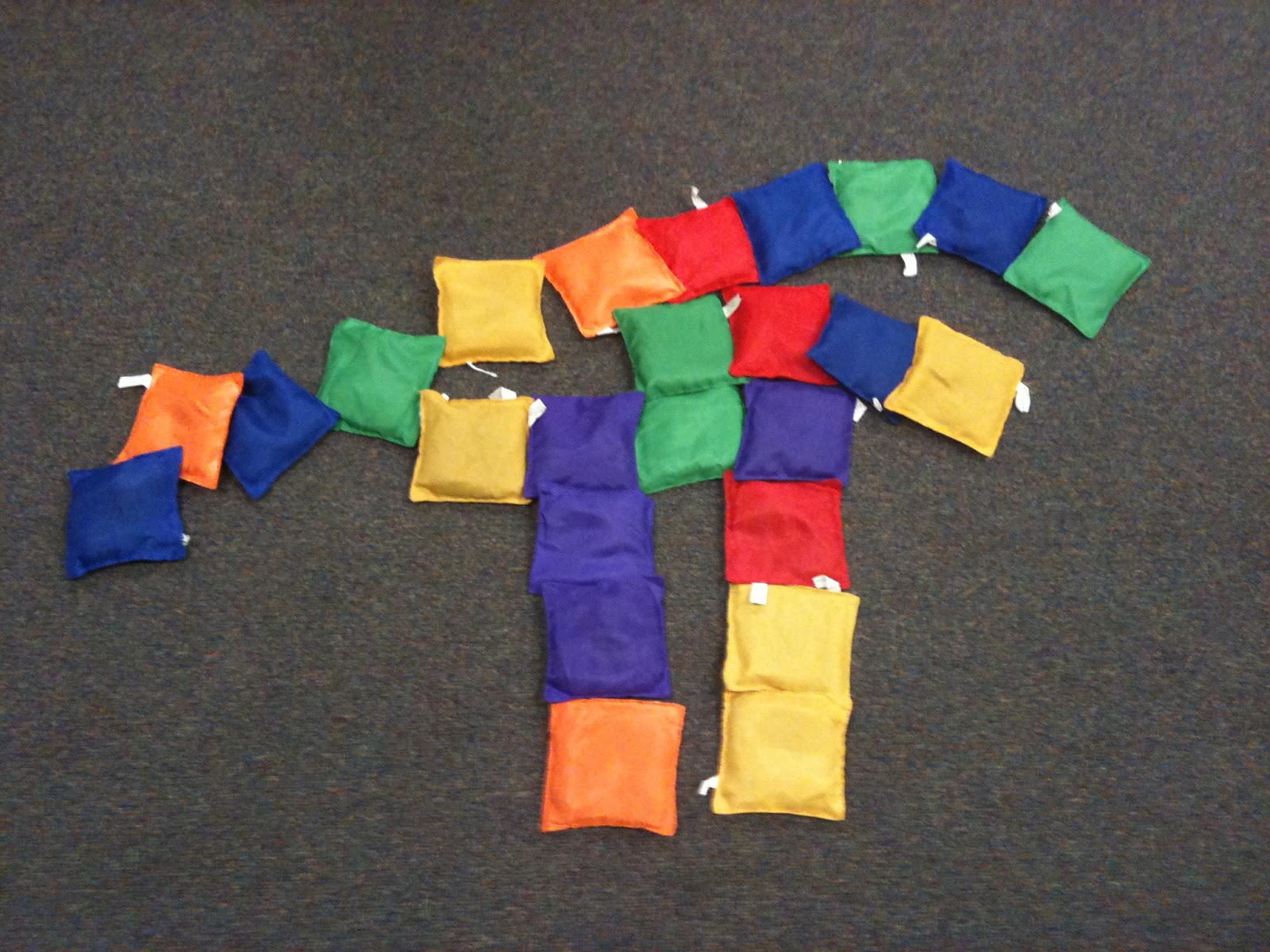
Spurred on by Lionni's inspiration, I divide my students into small groups and hand out classroom materials (scarves, cups, index cards, rainbow resonator bells, magnets, etc.) for them to create their own characters who might live in Pezzetino's world.  I take pictures of their work then share them with the whole class the next time I see them.  Then. again referring back to Lionni's use of names that describe the characters such as "The One Who Runs" and "The One On the Mountain," we discuss possible names for the characters they created in their groups.  Ultimately, I print out their pictures and present their teacher with this newly created version of the story.

So far, I have been unsuccessful with my attempts at using the color patterns in a more musical way.  I would like to use color patterns from the characters as a graphic score for music making.  For example, the greean/blue/purple/black color palette of The Swimming One could represent four different instruments or pitches.  This is something I'll keep working on.  Meanwhile, in her book Blue Is the Sea, Orff master teacher Sofia Lopez-Ibor suggests using the characters in Pezzetino as inspiration for movement.  There are many possibilities here. 

Here are some of the characters my students have created:


Thanks for visiting!  Don't forget to visit my store at Teachers Pay Teachers for other ideas!